
Dua for Parents in the Quran: 7 Beautiful Duas for Mother and Father
Dua for parents in the Quran is one of the most beautiful ways to show love, gratitude, and respect toward our mother and father. The Quran teaches believers to treat their parents with kindness and includes several heartfelt supplications that mention parents directly.
These Quranic duas ask Allah for mercy, forgiveness, gratitude, righteousness, and blessings. They are especially meaningful because they come from the words of prophets and righteous servants described in the Quran.
In this guide, we will look at 7 Quranic duas and supplications connected to parents, along with their Arabic text, transliteration, meaning, references, and the context behind each one.
A note about authenticity: The duas below are taken from the Quran itself. Where a verse contains a longer supplication, the wording is kept in its Quranic form rather than presenting a shortened version as though it were the original verse.
Why Make Dua for Parents?
Islam places great importance on kindness toward parents. The Quran repeatedly connects worship of Allah with good treatment of parents, and it teaches believers to speak to them with humility and mercy.
One of the most touching examples comes in Surah Al-Isra, where Allah instructs believers to show humility toward their parents and then teaches a beautiful prayer asking Allah to have mercy on them.
Making dua for your parents can therefore be more than simply repeating words. It can be a way of expressing gratitude for their sacrifices and asking Allah to reward them for the care they have given.
For living parents, these supplications can be accompanied by kindness, patience, service, and respectful speech. For parents who have passed away, asking Allah to forgive and have mercy upon them is especially meaningful.
1. Dua for Parents’ Mercy — Surah Al-Isra 17:24 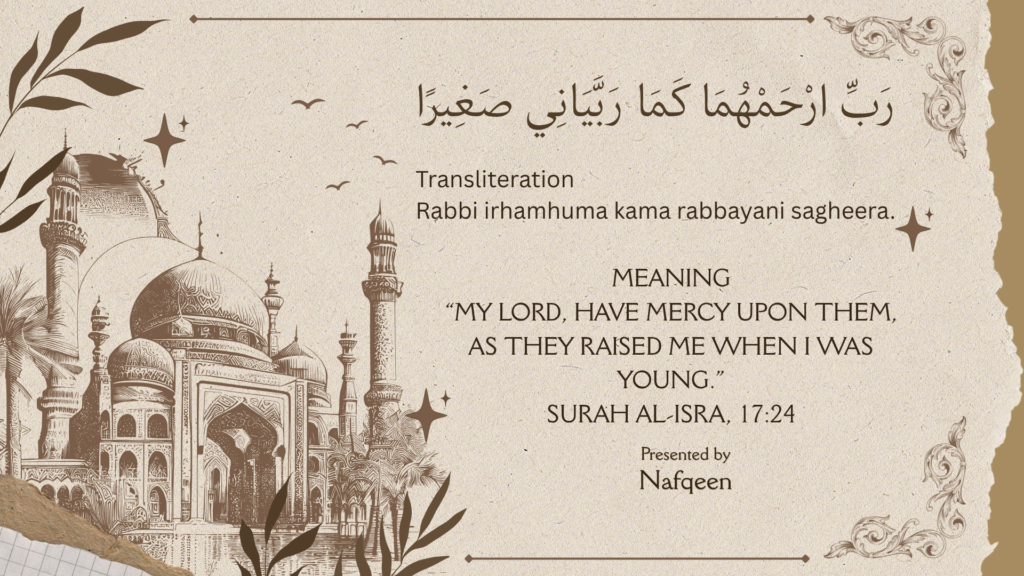
This is perhaps the most well-known dua for parents in the Quran.
Arabic
رَبِّ ارْحَمْهُمَا كَمَا رَبَّيَانِي صَغِيرًا
Transliteration
Rabbi irhamhuma kama rabbayani sagheera.
Meaning
“My Lord, have mercy upon them, as they raised me when I was young.”
The wording is deeply emotional because it connects the request for Allah’s mercy with the care parents gave during childhood. It reminds a person of a time when they depended completely on their parents.
This dua is especially beautiful to recite while thinking about the sacrifices your parents made for you when you were unable to care for yourself.
What this dua asks Allah for
The central request is Allah’s mercy upon both parents. It also carries a beautiful reminder of gratitude: the person making the dua remembers how their parents raised them when they were small.
It is short enough to memorize easily, making it a meaningful Quranic supplication to keep in your daily prayers and personal duas.
2. Dua for Forgiveness for Parents: Surah Ibrahim 14:41
Another powerful Quranic supplication appears in the dua of Prophet Ibrahim (peace be upon him).
Arabic
رَبَّنَا اغْفِرْ لِي وَلِوَالِدَيَّ وَلِلْمُؤْمِنِينَ يَوْمَ يَقُومُ الْحِسَابُ
Transliteration
Rabbana-ghfir lee wa liwalidayya wa lil-mu’mineena yawma yaqoomul-hisaab.
Meaning
“Our Lord, forgive me, my parents, and the believers on the Day the judgment will be established.”
— Surah Ibrahim, 14:41
Notice how the dua begins with a request for forgiveness for oneself, then includes one’s parents and the believers.
This makes it a beautiful supplication when asking Allah to forgive your parents and grant them His mercy.
Why this dua is meaningful
Forgiveness is one of the greatest things a believer can ask Allah to grant. This supplication teaches us not to think only of ourselves when making dua, but to remember our parents and other believers as well.
It can be recited as part of your personal dua, especially when you want to ask Allah for forgiveness for yourself and your parents together.
3. Dua for Gratitude for Parents: Surah An-Naml 27:19
Not every Quranic supplication about parents asks directly for forgiveness or mercy. Some ask Allah for the ability to recognize and appreciate His blessings.
In Surah An-Naml, Prophet Sulayman (Solomon) makes this beautiful dua after witnessing Allah’s blessings.
Arabic
رَبِّ أَوْزِعْنِي أَنْ أَشْكُرَ نِعْمَتَكَ الَّتِي أَنْعَمْتَ عَلَيَّ وَعَلَىٰ وَالِدَيَّ وَأَنْ أَعْمَلَ صَالِحًا تَرْضَاهُ وَأَدْخِلْنِي بِرَحْمَتِكَ فِي عِبَادِكَ الصَّالِحِينَ
Transliteration
Rabbi awzi’nee an ashkura ni’mataka allatee an’amta ‘alayya wa ‘alaa waalidayya wa an a’mala saalihan tardaahu wa adkhilnee birahmatika fee ‘ibaadikas-saaliheen.
Meaning
“My Lord, inspire me to be grateful for Your favor which You have bestowed upon me and my parents, to do righteous deeds that please You, and by Your mercy admit me among Your righteous servants.”
— Surah An-Naml, 27:19
This dua is beautiful because it connects gratitude toward Allah, gratitude for parents, righteous actions, and Allah’s mercy.
It reminds us that appreciating our parents should not remain only in our hearts. It should encourage us to become better people and do deeds that please Allah.
A Simple Way to Make Dua for Your Parents (Dua for parents in the Quran)
You don’t need complicated words to remember your parents in your dua.
You can begin by praising Allah, ask Him to forgive you and your parents, use the Quranic supplications above, and then make your own personal requests in whatever language you understand.
For example, you may ask Allah to:
- Give your parents good health and strength.
- Forgive their mistakes and shortcomings.
- Reward them for the sacrifices they made.
- Give them peace and contentment.
- Protect them from hardship.
- Increase them in faith and goodness.
- Grant them mercy and blessings.
The Quranic duas provide beautiful words, while a sincere personal dua allows you to speak to Allah about the specific needs of your parents.
4. Dua for Gratitude and Righteousness: Surah Al-Ahqaf 46:15
Another beautiful dua for parents in the Quran appears in Surah Al-Ahqaf. The verse first reminds us of the sacrifices of parents, particularly the hardship a mother experiences during pregnancy and childbirth. It then gives the words of a supplication asking Allah for gratitude, righteous actions, and goodness for one’s family.
Arabic
رَبِّ أَوْزِعْنِي أَنْ أَشْكُرَ نِعْمَتَكَ الَّتِي أَنْعَمْتَ عَلَيَّ وَعَلَىٰ وَالِدَيَّ وَأَنْ أَعْمَلَ صَالِحًا تَرْضَاهُ وَأَصْلِحْ لِي فِي ذُرِّيَّتِي ۖ إِنِّي تُبْتُ إِلَيْكَ وَإِنِّي مِنَ الْمُسْلِمِينَ
Transliteration
Rabbi awzi’nee an ashkura ni’mataka allatee an’amta ‘alayya wa ‘alaa waalidayya wa an a’mala saalihan tardaahu wa aslih lee fee dhurriyyatee, innee tubtu ilayka wa innee minal-muslimeen.
Meaning
“My Lord, inspire me to be thankful for Your favor which You have bestowed upon me and upon my parents, and to do righteous deeds that please You, and make my offspring righteous. I have repented to You, and I am truly one of the Muslims.”
— Surah Al-Ahqaf, 46:15
Why This Dua Is Special
This supplication goes beyond simply asking Allah to bless parents. It asks for the ability to recognize and appreciate the blessings Allah has given both you and your parents.
It also connects gratitude with righteous action and asks Allah to make one’s offspring righteous. That makes this a beautiful dua for someone who wants goodness to continue through generations.
5. Dua for Forgiveness for Parents: Surah Nuh 71:28
Prophet Nuh (peace be upon him) also made a beautiful supplication that included his parents. He asked Allah for forgiveness for himself, his parents, the believers who entered his home in faith, and believing men and women.
Arabic
رَبِّ اغْفِرْ لِي وَلِوَالِدَيَّ وَلِمَنْ دَخَلَ بَيْتِيَ مُؤْمِنًا وَلِلْمُؤْمِنِينَ وَالْمُؤْمِنَاتِ ۖ وَلَا تَزِدِ الظَّالِمِينَ إِلَّا تَبَارًا
Transliteration
Rabbi ighfir lee wa liwaalidayya wa liman dakhala baytiya mu’minan wa lil-mu’mineena wal-mu’minaat, wa laa tazidiz-zaalimeena illaa tabaaraa.
Meaning
“My Lord, forgive me, my parents, and whoever enters my house in faith, and all believing men and women. And increase the wrongdoers only in destruction.”
— Surah Nuh, 71:28
What We Can Learn From This Dua
The supplication shows how a believer can remember others while making dua for themselves. Prophet Nuh included his parents alongside other believers.
For someone making dua for their own parents, the first part is particularly meaningful: asking Allah to forgive them and show them His mercy.
6. A Quranic Dua for Family and Future Generations
The Quran also contains supplications that focus on one’s family and descendants. Although these verses do not specifically ask Allah for parents, they can complement the parent-focused duas in this article.
One beautiful example is the dua of Prophet Ibrahim (peace be upon him):
Arabic
رَبِّ اجْعَلْنِي مُقِيمَ الصَّلَاةِ وَمِنْ ذُرِّيَّتِي ۚ رَبَّنَا وَتَقَبَّلْ دُعَاءِ
Transliteration
Rabbij’alnee muqeemas-salaati wa min dhurriyyatee, rabbanaa wa taqabbal du’aa.
Meaning
“My Lord, make me an establisher of prayer, and [many] from my descendants. Our Lord, and accept my supplication.”
— Surah Ibrahim, 14:40
This is especially meaningful for parents who want to ask Allah to keep their children connected to prayer and righteousness.
It also reminds us that making dua for family is not limited to asking for worldly success. A believer can ask Allah for faith, obedience, and a righteous family.
7. A Dua for Righteous Family: Connecting Parents and Children
Another related Quranic supplication asks Allah for righteous family members and descendants:
Arabic
رَبَّنَا هَبْ لَنَا مِنْ أَزْوَاجِنَا وَذُرِّيَّاتِنَا قُرَّةَ أَعْيُنٍ وَاجْعَلْنَا لِلْمُتَّقِينَ إِمَامًا
Transliteration
Rabbanaa hab lanaa min azwaajinaa wa dhurriyyaatinaa qurrata a’yunin waj’alnaa lil-muttaqeena imaamaa.
Meaning
“Our Lord, grant us from our spouses and offspring comfort to our eyes and make us an example for the righteous.”
— Surah Al-Furqan, 25:74
This is not specifically a dua for parents, so it should not be presented as one. Rather, it is a related Quranic family supplication that can be included when discussing prayers for a righteous and loving family.
An Important Note About the Seven Duas
For accuracy, there are five Quranic supplications in this article that directly mention parents: 17:24, 14:41, 27:19, 46:15, and 71:28. The final two are related Quranic family duas rather than direct prayers for parents. The Quranic text confirms the parent-related passages and their wording.
I recommend keeping this distinction in the final article because Nafqeen should never label a general family dua as a specific “dua for parents” simply to reach a number.
How to Make Dua for Living Parents (Dua for parents in the Quran)
If your parents are alive, these Quranic supplications can be part of a broader habit of remembering them in your prayers.
You can ask Allah to:
- Bless them with good health and strength.
- Increase them in faith and righteousness.
- Forgive their mistakes and shortcomings.
- Protect them from hardship and harm.
- Give them peace and contentment.
- Reward them for the sacrifices they made.
- Put barakah in their lives.
- Allow you to treat them with kindness and patience.
But dua should not replace good treatment. The Quran’s teaching about parents also emphasizes kindness and respectful behavior toward them. The Quranic Arabic Corpus records the command to show goodness toward parents alongside several passages concerning parents.
Making Dua for Parents Who Have Passed Away
If a parent has passed away, remembering them in dua can be a deeply meaningful act.
The Quran specifically contains prayers asking Allah for forgiveness for parents, including the supplications of Ibrahim and Nuh.
You can also ask Allah in your own words to forgive your deceased parent, have mercy upon them, raise their rank, and grant them Jannah.
When Is the Best Time to Make Dua for Parents?
There is no single time when you are required to make dua for your parents. You can remember them in your supplications whenever you sincerely turn to Allah.
Some moments can be especially meaningful for making personal dua, such as:
- During your daily prayers.
- After completing your salah.
- During the last part of the night.
- When you are feeling especially grateful for your parents.
- When your parents are facing a difficult situation.
- When remembering a parent who has passed away.
- Whenever something reminds you of their sacrifices and kindness.
The important thing is sincerity. You do not need to wait for a particular occasion to ask Allah to bless, forgive, and have mercy upon your parents.
Can You Make Dua for Parents in Your Own Language?
Yes. When making personal dua, you can ask Allah for your parents in a language you understand. You can use the Quranic supplications in Arabic and then express your own heartfelt requests in your own words.
For example, after reciting:
رَبِّ ارْحَمْهُمَا كَمَا رَبَّيَانِي صَغِيرًا
you might personally ask Allah to give your mother and father good health, forgive them, protect them, and reward them for everything they have done for you.
This distinction is important: the Quranic wording should be attributed to the Quran, while your own words should be described as a personal dua rather than a Quranic or Prophetic supplication.
How to Memorize These Quranic Duas
You don’t have to memorize all the longer supplications at once.
Start with the short dua from Surah Al-Isra:
Rabbi irhamhuma kama rabbayani sagheera.
Repeat it regularly until the words become familiar. Then gradually learn the longer supplications.
A simple approach is:
- Read the Arabic slowly.
- Learn the meaning.
- Listen to the pronunciation from a reliable Quran source.
- Repeat one short section several times.
- Try reciting it without looking.
- Review it regularly rather than trying to memorize everything in one day.
Understanding the meaning can also make memorization more meaningful because you know exactly what you are asking Allah for.
Dua for Mother and Father Together (Dua for parents in the Quran)
Several of the Quranic supplications mentioned above explicitly include both parents.
One of the simplest is:
رَبِّ ارْحَمْهُمَا كَمَا رَبَّيَانِي صَغِيرًا
Rabbi irhamhuma kama rabbayani sagheera.
“My Lord, have mercy upon them, as they raised me when I was young.”
The word “huma” refers to two people, making this supplication particularly suitable when asking Allah for mercy upon both parents together.
Another powerful example is:
رَبَّنَا اغْفِرْ لِي وَلِوَالِدَيَّ
Rabbana-ghfir lee wa liwalidayya.
“Our Lord, forgive me and my parents.”
This comes from the longer supplication in Surah Ibrahim 14:41.
Dua for a Mother
The Quran does not provide a separate supplication specifically addressed only to one’s mother in the same way that some people might expect. Instead, the Quran gives supplications that mention both parents.
The dua from Surah Al-Isra is therefore beautiful for a mother as well:
رَبِّ ارْحَمْهُمَا كَمَا رَبَّيَانِي صَغِيرًا
You can recite the Quranic wording and then make a personal dua for your mother, asking Allah to bless her with health, peace, forgiveness, and mercy.
The Quran also specifically reminds believers of the difficulties mothers experience during pregnancy and childbirth in Surah Al-Ahqaf 46:15. That makes the passage particularly moving when reflecting on a mother’s sacrifices.
Dua for a Father
The same Quranic supplications can be made for a father because several of them explicitly mention parents together.
You can recite:
رَبِّ ارْحَمْهُمَا كَمَا رَبَّيَانِي صَغِيرًا
and then personally ask Allah to bless your father, forgive him, protect him, and reward him for his efforts and sacrifices.
The Quran’s teachings about parents are not limited to biological motherhood or fatherhood as titles. They encourage believers to respond to their parents with kindness, humility, and gratitude.
What Makes These Duas Different From Ordinary Birthday Wishes?
This is an important distinction for anyone reading Nafqeen.
A birthday wish is generally a personal message written to express love, affection, congratulations, or good wishes. A Quranic dua, however, has a completely different source: it comes from the revealed words of the Quran.
For that reason, we should not change Quranic wording and then present the modified version as though it were a verse.
There is nothing wrong with making a personal dua for your parents in your own words. The important thing is simply to make the distinction clear.
For Nafqeen, this approach keeps the Dua section faith-conscious, transparent, and useful rather than presenting every beautiful Islamic-sounding sentence as an authentic dua.
A Simple Personal Dua for Your Parents (Dua for parents in the Quran)
After reciting the authentic Quranic supplications, you can also speak to Allah about your parents in your own words.
For example:
“O Allah, bless my parents with Your mercy and forgiveness. Reward them for every sacrifice they have made for me. Give them good health, peace, and strength, protect them from hardship, and keep our family upon goodness and faith. Ameen.”
This is a personal dua, not a Quranic verse or Prophetic hadith. It is perfectly appropriate to label it that way.
Final Thoughts
The most beautiful dua for parents in the Quran is not simply something to memorize and recite mechanically. These supplications remind us to recognize our parents’ sacrifices, ask Allah for their forgiveness and mercy, and respond to them with gratitude and kindness.
The short prayer from Surah Al-Isra captures this beautifully:
“My Lord, have mercy upon them, as they raised me when I was young.”
Whether your parents are beside you today or you are remembering a parent who has passed away, making sincere dua for them is a meaningful way to keep them in your heart.
May Allah forgive our parents, shower them with His mercy, reward them for every sacrifice they have made, and guide us to treat them with the kindness and respect they deserve. Ameen. That’s Dua for parents in the Quran.
Pingback: Dua for Entering and Leaving Home – Arabic & Meaning