
Dua Before Sleeping: Authentic Sunnah Duas for a Peaceful Night
Dua before sleeping is one of the simple ways a Muslim can end the day by remembering Allah and placing their trust in Him. The Prophet ﷺ taught several authentic supplications and bedtime practices that can be followed before going to sleep.
These practices are not simply about having a peaceful night. They help a believer end the day with remembrance of Allah, reliance upon Him, and preparation for sleep in accordance with the Sunnah.
Why Make Dua Before Sleeping? 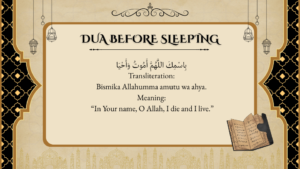
Nighttime brings the day to an end, making it a natural moment to pause and remember Allah.
The Prophet ﷺ taught specific words to say before going to bed, including the short supplication:
بِاسْمِكَ اللَّهُمَّ أَمُوتُ وَأَحْيَا
Transliteration:
Bismika Allahumma amutu wa ahya.
Meaning:
“In Your name, O Allah, I die and I live.”
This dua is authentically reported in Sahih al-Bukhari 6312/6314, where Hudhayfah رضي الله عنه narrated that the Prophet ﷺ would say it when going to bed.
The wording is short, but its meaning is profound. Sleep reminds us of our dependence upon Allah, while waking reminds us that life itself is a blessing from Him.
The Main Dua Before Sleeping
One of the most comprehensive authentic supplications before sleeping was taught by the Prophet ﷺ to al-Bara’ ibn ‘Azib رضي الله عنه.
اللَّهُمَّ أَسْلَمْتُ نَفْسِي إِلَيْكَ، وَفَوَّضْتُ أَمْرِي إِلَيْكَ، وَوَجَّهْتُ وَجْهِي إِلَيْكَ، وَأَلْجَأْتُ ظَهْرِي إِلَيْكَ، رَغْبَةً وَرَهْبَةً إِلَيْكَ، لَا مَلْجَأَ وَلَا مَنْجَا مِنْكَ إِلَّا إِلَيْكَ، آمَنْتُ بِكِتَابِكَ الَّذِي أَنْزَلْتَ، وَبِنَبِيِّكَ الَّذِي أَرْسَلْتَ
Transliteration:
Allahumma aslamtu nafsi ilaika, wa fawwadtu amri ilaika, wa wajjahtu wajhi ilaika, wa alja’tu zahri ilaika, raghbatan wa rahbatan ilaika. La malja’a wa la manja minka illa ilaika. Amantu bikitabikal-ladhi anzalta, wa nabiyyikalladhi arsalta.
Meaning:
“O Allah, I submit myself to You, entrust my affairs to You, turn my face toward You, and rely upon You, hoping in You and fearing You. There is no refuge and no escape from You except to You. I believe in Your Book which You have revealed and in Your Prophet whom You have sent.”
The Prophet ﷺ instructed al-Bara’ رضي الله عنه to say these words when going to bed and taught that if a person died that night after saying them, they would die upon Islam. This narration is recorded in Sahih al-Bukhari 6313.
A Simple Way to Understand This Dua
The supplication brings together several important meanings:
- Submission: entrusting yourself to Allah.
- Tawakkul: leaving your affairs in Allah’s care.
- Hope and fear: turning to Allah with both hope and reverence.
- Faith: affirming belief in Allah’s revealed Book and His Prophet ﷺ.
- Dependence: recognizing that there is no true refuge or escape from Allah except by turning to Him.
It is therefore much more than a bedtime phrase. It is a reminder of where a believer’s heart should be before falling asleep.
Sleep According to the Sunnah
The bedtime supplications were accompanied by practical guidance as well.
The Prophet ﷺ instructed al-Bara’ رضي الله عنه that when he wanted to go to bed, he should perform wudu as he would for prayer, then lie down on his right side and recite the supplication.
Another narration also describes the Prophet ﷺ going to bed on his right side and reciting the same comprehensive dua.
This gives us a simple bedtime routine: prepare yourself for sleep, remember Allah, recite an authentic supplication, and place your affairs in His hands.
If you have already read our guide on the Dua for Entering and Leaving Home, this bedtime dua can become another part of the same daily habit of remembering Allah during ordinary moments.
Ayat al-Kursi Before Sleeping
One of the most well-known Quranic practices before sleeping is reciting Ayat al-Kursi, the 255th verse of Surah Al-Baqarah.
A narration in Sahih al-Bukhari 2311 reports that Abu Hurairah رضي الله عنه was told to recite Ayat al-Kursi when going to bed. The Prophet ﷺ later confirmed that the advice was true, even though it had originally come from Shaytan. The narration mentions protection through the night and that Shaytan would not come near the person until morning.
For this reason, reciting Ayat al-Kursi before sleeping is an important Sunnah-based practice to include in your nighttime routine.
You can find the verse in Surah Al-Baqarah 2:255 and recite it in full before going to sleep.
Reciting the Three Quls Before Sleeping
Another established Sunnah is to recite the final three short surahs of the Quran:
- Surah Al-Ikhlas — 112
- Surah Al-Falaq — 113
- Surah An-Nas — 114
‘Aishah رضي الله عنها narrated that when the Prophet ﷺ went to bed each night, he would cup his hands together, blow into them, recite these three surahs, and then wipe his hands over as much of his body as he could. He would do this three times. This is recorded in Sahih al-Bukhari 5017.
How to Perform This Sunnah
The practice can be done quite simply:
- Cup your hands together.
- Recite Surah Al-Ikhlas.
- Recite Surah Al-Falaq.
- Recite Surah An-Nas.
- Blow gently into your hands.
- Wipe your hands over the parts of your body you can reach.
- Repeat the process three times.
This is a beautiful way to end the day with Quran and remembrance of Allah.
A Simple Bedtime Routine From the Sunnah
With the practices mentioned so far, you can create a simple routine without making bedtime unnecessarily complicated.
Before Getting Into Bed
If possible, perform wudu as you would for prayer. The Prophet ﷺ instructed al-Bara’ ibn ‘Azib رضي الله عنه to do this before going to bed. He also instructed him to lie on his right side and recite the bedtime supplication.
Once You Are Ready to Sleep
You can then:
- Recite Ayat al-Kursi.
- Recite Al-Ikhlas, Al-Falaq, and An-Nas and wipe over your body three times.
- Recite the comprehensive bedtime dua discussed in Part 1.
- Say the short dua: Bismika Allahumma amutu wa ahya.
- Lie down on your right side.
You do not need to feel overwhelmed by trying to memorize everything immediately. Start with one practice and gradually learn the others.
If you regularly make dua for your family, you can also explore our guide to Dua for Children in the Quran for authentic Quranic supplications concerning righteous offspring.
What About Dua After Waking Up? 
The Sunnah does not only teach us what to say before sleeping. There is also a beautiful supplication to say after waking.
The Prophet ﷺ said that when he woke up, he would say:
الْحَمْدُ لِلَّهِ الَّذِي أَحْيَانَا بَعْدَ مَا أَمَاتَنَا وَإِلَيْهِ النُّشُورُ
Transliteration:
Alhamdu lillahil-ladhi ahyana ba’da ma amatana wa ilayhin-nushur.
Meaning:
“All praise is for Allah who gave us life after causing us to die, and to Him is the resurrection.”
This creates a beautiful connection between the beginning and end of the day: we go to sleep remembering our dependence on Allah and wake up thanking Him for giving us another day.
A Few Important Things to Remember
When learning dua before sleeping, it is helpful to focus on what is actually established from the Quran and authentic Sunnah rather than trying to memorize every prayer associated with bedtime.
The Prophet ﷺ taught different supplications and practices for different occasions, and they can be followed according to your ability. You do not have to complete a long list every night to benefit from the Sunnah.
One of the clearest bedtime instructions is to make wudu, lie on the right side, and recite the prescribed supplication.
Do I Have to Memorize Every Dua?
No. If you are just beginning, start with a short supplication such as:
بِاسْمِكَ اللَّهُمَّ أَمُوتُ وَأَحْيَا
Bismika Allahumma amutu wa ahya.
Meaning:
“In Your name, O Allah, I die and I live.”
This short dua is authentically reported from the Prophet ﷺ in Sahih al-Bukhari 6312.
As you become familiar with it, you can gradually learn the longer supplication and other established bedtime practices.
A Simple Sunnah Bedtime Checklist
For someone who wants a practical routine, the following checklist can make things easier:
- Make wudu before going to bed when possible.
- Lie down on your right side.
- Recite the comprehensive bedtime dua.
- Recite Ayat al-Kursi.
- Recite Surah Al-Ikhlas, Al-Falaq, and An-Nas.
- Blow into your cupped hands and wipe over your body three times.
- Say: Bismika Allahumma amutu wa ahya.
- Sleep while remembering Allah and placing your trust in Him.
The practices involving wudu and sleeping on the right side are established in Sahih al-Bukhari, while the practice of reciting the three Quls and wiping over the body three times is reported in Sahih al-Bukhari 5017.
You don’t need to turn this into a stressful checklist. The purpose is to make remembrance of Allah a natural part of your night.
What to Say When You Wake Up
The Sunnah also gives us a beautiful dua for the moment we wake:
الْحَمْدُ لِلَّهِ الَّذِي أَحْيَانَا بَعْدَ مَا أَمَاتَنَا وَإِلَيْهِ النُّشُورُ
Transliteration:
Alhamdu lillahil-ladhi ahyana ba’da ma amatana wa ilayhin-nushur.
Meaning:
“All praise is for Allah who gave us life after causing us to die, and to Him is the resurrection.”
This is reported in Sahih al-Bukhari 6312, in the same narration that mentions the dua said when going to sleep.
So the beginning and end of sleep can both become moments of remembrance: we remember Allah before sleeping and thank Him when we wake.
Final Thoughts
The dua before sleeping is not simply a collection of words to memorize. These supplications teach a believer to end the day with faith, gratitude, dependence upon Allah, and trust in Him.
Even if you begin with just one authentic dua, make it a consistent habit. Then, as you learn more, gradually incorporate the other Sunnah practices into your nighttime routine.
May Allah protect us through every night, forgive our shortcomings, give us peaceful and beneficial rest, and allow us to wake each morning with grateful hearts.
Frequently Asked Questions (FAQ)
What is the shortest dua before sleeping?
A short authentic dua is:
Bismika Allahumma amutu wa ahya: “In Your name, O Allah, I die and I live.” It is reported in Sahih al-Bukhari 6312.
What should I recite before sleeping for protection?
Among the established practices are reciting Ayat al-Kursi and reciting Al-Ikhlas, Al-Falaq, and An-Nas before sleeping. The three Quls are specifically reported in Sahih al-Bukhari 5017.
Should I sleep on my right side?
The Prophet ﷺ instructed al-Bara’ ibn ‘Azib رضي الله عنه to perform wudu and then lie down on his right side before reciting the bedtime supplication.
What dua should I say after waking up?
You can say:
Alhamdu lillahil-ladhi ahyana ba’da ma amatana wa ilayhin-nushur.
It means: “All praise is for Allah who gave us life after causing us to die, and to Him is the resurrection.”
Do I have to say all the bedtime duas every night?
No. There are several authentic practices, and you can learn them gradually. Consistency in remembering Allah is more practical than making the routine unnecessarily difficult.
Authentic References
- Sahih al-Bukhari 6311: Wudu, right-side sleeping, and the comprehensive bedtime supplication.
- Sahih al-Bukhari 6312: Dua before sleeping and dua upon waking.
- Sahih al-Bukhari 5017: Reciting Al-Ikhlas, Al-Falaq, and An-Nas before sleeping.
Pingback: Dua Before Driving a Car: What to Say in Islam
Pingback: Dua for Entering and Leaving the Bathroom: Arabic & Meaning
Pingback: Dua After Waking Up: Arabic, Transliteration & Meaning
Pingback: Dua Before and After Eating: Arabic, Meaning & Source