
Dua for Entering and Leaving Home: Authentic Sunnah Supplications
The dua for entering and leaving home is a simple way to remember Allah when beginning and ending our time at home. Islam teaches believers to keep Allah in their remembrance during everyday activities, including entering and leaving their homes.
The Prophet Muhammad ﷺ taught supplications and practices connected with leaving the home, and authentic narrations also emphasize remembering Allah when entering the home. These short duas can become an easy part of your daily routine.
In this guide, you will find the Arabic wording, transliteration, English meaning, hadith references, and a simple explanation of how these supplications can be incorporated into everyday life.
Why Make Dua When Entering and Leaving Home?
Home is where we spend much of our daily lives. Remembering Allah when entering and leaving helps turn an ordinary routine into an opportunity for worship and remembrance.
The Sunnah teaches us to mention Allah when entering our homes and to seek His guidance and protection when going outside. An authentic narration from Jabir ibn Abdullah explains that when a person mentions Allah upon entering the home and when eating, Satan has no place to stay or eat there.
This is a small practice, but it can help develop a habit of remembering Allah throughout the day.
Dua for Entering the Home
One authentic teaching concerning entering the home is to mention Allah’s name when entering.
The Prophet ﷺ said that when a person enters his house and mentions Allah’s name when entering and when eating, Satan says that there is no place for him to stay or eat.
What to Say When Entering 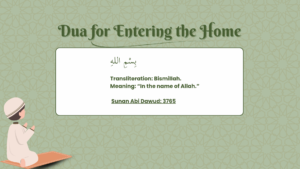
A simple wording is:
بِسْمِ اللهِ
Transliteration
Bismillah.
Meaning
“In the name of Allah.”
The important point established by the authentic narration is remembering Allah’s name when entering the home. The hadith does not require us to use a particular long formula for this practice.
Say Salam to Your Family
The longer narration reported in Sunan Abi Dawud also mentions greeting the people in the home after entering. However, that particular narration is graded weak by al-Albani, so it should not be presented as an unquestionably authentic hadith.
Greeting your family with As-Salamu Alaikum is nevertheless an important Islamic practice and a beautiful way to bring peace and warmth into the home.
Why Saying Bismillah When Entering Home Matters
The authentic narration from Jabir gives a clear reason for remembering Allah when entering.
When a person enters while mentioning Allah, Satan is deprived of the opportunity to claim the home as a place to stay. The same narration connects remembering Allah at entry with remembering Him before eating.
This teaches us something simple but powerful: small acts of remembrance can have a meaningful place in everyday Muslim life.
If you are interested in other family-centered duas, you can also read our guide on [Dua for Parents in the Quran].
That is the best place for your first internal link because the reader is already thinking about the spiritual wellbeing of the family and home.
Dua for Leaving the Home 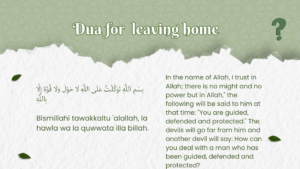
The Prophet ﷺ also taught a specific supplication to say when leaving the home.
Arabic
بِسْمِ اللَّهِ تَوَكَّلْتُ عَلَى اللَّهِ لَا حَوْلَ وَلَا قُوَّةَ إِلَّا بِاللَّهِ
Transliteration
Bismillahi tawakkaltu ‘alallah, la hawla wa la quwwata illa billah.
Meaning
“In the name of Allah, I place my trust in Allah. There is no might and no power except with Allah.”
— Sunan Abi Dawud 5095; Jami` at-Tirmidhi 3426
What This Dua Means
This short supplication combines three beautiful ideas:
Bismillah: beginning with Allah’s name.
Tawakkaltu ‘alallah: placing your trust in Allah.
La hawla wa la quwwata illa billah: recognizing that all strength and power ultimately belong to Allah.
It is therefore more than a request for protection. It is also an expression of tawakkul, or reliance upon Allah.
What Happens When You Say This Dua?
The narration in Sunan Abi Dawud states that when a person says this supplication upon leaving the house, it is said to him that he has been guided, sufficed, and protected, and the devils move away from him.
The same supplication is recorded in Jami` at-Tirmidhi, where the narration describes the person as being sufficed and protected and Satan moving away.
This makes the dua a beautiful daily habit for a Muslim whenever they step outside their home.
Common Questions About the Dua for Entering and Leaving Home
What is the dua for leaving home?
The most well-known authentic dua for leaving home is:
بِسْمِ اللَّهِ تَوَكَّلْتُ عَلَى اللَّهِ لَا حَوْلَ وَلَا قُوَّةَ إِلَّا بِاللَّهِ
Transliteration:
Bismillahi tawakkaltu ‘alallah, la hawla wa la quwwata illa billah.
Meaning:
“In the name of Allah, I place my trust in Allah. There is no might and no power except with Allah.”
The hadith states that the person who says this when leaving is told that they have been guided, sufficed, and protected.
What should I say when entering my home?
The authentic narration emphasizes mentioning Allah’s name when entering the home. The Prophet ﷺ taught that when a person enters their home and remembers Allah, along with mentioning Allah’s name over their food, Satan has no place to spend the night or eat.
So, saying Bismillah when entering is a simple way to keep Allah’s remembrance present in your home.
Is there a specific long dua for entering the home?
A longer dua beginning with “Allahumma inni as’aluka khayral-mawlaji wa khayral-makhraji…” is recorded in Sunan Abi Dawud 5096. However, that narration is graded Da’if (weak) by al-Albani.
For this reason, it is better to clearly distinguish that narration from the shorter practices supported by stronger evidence rather than presenting the longer wording as unquestionably authentic.
Can I make my own dua when entering or leaving home?
Yes. You can make personal dua to Allah for your safety, family, livelihood, guidance, or anything else that is permissible.
The important distinction is that a personal dua should not be presented as a specific Sunnah dua unless there is evidence that the Prophet ﷺ taught or practiced it.
Is there another authentic dua for leaving home?
Yes. Another authentic supplication reported from Umm Salamah رضي الله عنها begins:
اللَّهُمَّ إِنِّي أَعُوذُ بِكَ أَنْ أَضِلَّ أَوْ أُضَلَّ…
It asks Allah for protection from going astray, being led astray, doing wrong, suffering injustice, and acting ignorantly or being treated with ignorance. The narration is recorded in Sunan Abi Dawud 5094 and graded Sahih by al-Albani.
Why These Small Duas Matter
Leaving and entering your home may feel like an ordinary part of the day, but Islam teaches us to turn ordinary moments into opportunities for remembering Allah.
The dua when leaving reminds you to trust Allah rather than relying only on your own strength. The remembrance when entering reminds you to bring Allah’s name into your home and family life.
These are short practices, but consistency is what gives them a lasting place in everyday life.
You do not need to wait for a special occasion to make these duas. Say them when you leave for work, school, shopping, travel, the masjid, or any other destination. Remember Allah when you return home as well.
A Simple Reminder to Keep
If you only want to memorize one dua first, start with the leaving-home supplication:
بِسْمِ اللَّهِ تَوَكَّلْتُ عَلَى اللَّهِ لَا حَوْلَ وَلَا قُوَّةَ إِلَّا بِاللَّهِ
Bismillahi tawakkaltu ‘alallah, la hawla wa la quwwata illa billah.
Then make it a habit every time you leave your home.
When you return, remember Allah as you enter and greet your family.
May Allah make our homes places of peace, remembrance, protection, and barakah, and may He help us follow the authentic Sunnah in both the small and important moments of our lives.
References
- Sunan Abi Dawud 5095: Dua when leaving the home.
- Sunan Abi Dawud 5094: Another authentic supplication reported when leaving the home.
- Sunan Abi Dawud 3765: Mentioning Allah when entering the home and before eating.
- Sunan Abi Dawud 5096: Longer entering-home narration, graded weak by al-Albani.
Pingback: Dua Before Sleeping – Authentic Sunnah Duas & Meaning
Pingback: Dua for a New Home in Islam: What to Say When Moving In
Pingback: Dua Before Driving a Car: What to Say in Islam
Pingback: Dua When It Rains: Arabic, Meaning & Hadith
Pingback: Dua for Entering and Leaving the Bathroom: Arabic & Meaning
Pingback: Dua Before and After Eating: Arabic, Meaning & Source